Wednesday, April 27, 2016
Project Brazil (Part 2)
Rio de Janeiro alone has 10,000,000 people. A couple of million less than the people in Metro Manila.
4. Their most reliable means of transportation is the taxi. Meter starts at 5.40 Reals (about 75 Pesos or $1.60 flag down rate). While taxi is relatively not expensive, moving from one part of the city to another part is quite expensive if you're using a cab. A whole day of travel would easily be around 100 Reals (1,350 Pesos). Word of advise - ask the concierge where are the places you want to go to. See if your schedule can work around those that are nearest to each other so that you won't have to spend too much on cab fare. The bus and other systems are not as reliable and you don't want ending up getting mugged. Get the yellow taxi cab and one that has a meter. Oh yeah, and always ask for a receipt after!
5. Plan your day ahead. Don't have random thoughts. For example, you can do Christ the Redeemer in 15 minutes. The travel time, however, is a different story altogether. Even the Sugar Loaf Hills can be accomplished in 1 hour or less. For both these historic sites in Rio, you can have one morning or one afternoon and you'd have seen both. But that's about it. There's really nothing much to see in these sites and on a weekday, there's absolutely no queue and you get the best photo ops. The Jardim Botanico is also one of the recommended places to go, but I would ask every one to skip it especially if you don't like getting bitten by mosquitoes. While we ventured to the place to see the orchidarium, the orchids were not in bloom and was a paltry compared to the Singaporean Orchid Gardens. For all these three places, nothing was free. There is an entrance fee.
6. Don't act like the millionaire from the other side of the world. Most of the people here in Brazil are poor. Even the cars that are on the street are older versions compared to what we have in Manila. The malls are not hip or jaw-drop fabulous compared the malls in Manila. They are small, expensive and way more expensive than if you buy them in Manila. Their most modern mall is the Village Mall in the Barras area, around 1 hour away from Copacabana and Ipanema (or almost 100 Reals taxi ride).
Which goes to the point that unless you plan to drive your own car or get a chauffeur from the hotel to bring you from point A to point B, leave your valuables and your jewelry in the hotel. You don't want to get robbed in broad daylight. As one Filipino OFW told us, don't flash your cash and your stash around unless you want to end up dead.
Brazil was one of the more affluent South American countries. Unfortunately, according to people here, corruption in the government has driven the country to the brink of bankruptcy. Denominations are old. Politicians are corrupt. Poverty is at an all time high. Health problems like the Zika virus and sexually transmitted diseases have pushed the country to the brink of global health emergencies.
While people love to party, be careful where you go to and whom you bring home with you.
7. The standard shops abound - Starbucks, Outback, McDonalds....but don't expect convenience stores like 7/11, Family Mart and Mini Mart. Supermarkets are rarely found around the area and when you do get to find a convenience store, it looks like it was raided by thugs an hour ago. Food is not cheap, but it's not too expensive either. The average meal should cost you around 25 Reals in the fast food shops (that's around 350 pesos). A churrasco would cost you around $100 (350 Reals) for two people, not including drinks. The cost of living is high, which explains why more people are pushed into more poverty. Coming to a third world country with a high standard of living makes you feel how lucky one is to live in the Philippines (seriously)!
(To be continued)
Tuesday, April 26, 2016
Project Brazil
It was a 37 hours flight from Manila to Singapore to Barcelona to Sao Paolo to Rio de Janeiro on Singapore Airlines. I didn't think I would have lasted a flight this long or a trip this far. But we landed in Rio a few hours earlier and for those traveling from the Philippines to any South American country, here are a few trips, which I will call - Project Brazil:
1. Don't fly on economy class if the trip will take more than 24 hours. It's bad enough to be on a plane that will take more than 10 hours on economy class. It's guaranteed that when you arrive, you will feel like part of the baggage compartment. With that said, there are many flights into Brazil from Manila, Philippines. Because Brazil is on the East side of the continent, flying through Europe or the Middle East will be the shorter route. Emirates will take you there with one technical stop in Dubai. Qatar & Etihad have no direct flights into Rio de Janeiro and will need to stop through Sao Paolo. From Sao Paolo there are several local airlines that you can take to Rio. I suggest that instead of going into the Galeao International Airport (GIG) in Rio (if you're coming into Sao Paolo), take the SDU or Santos Dumont Airport. There are more flights from Sao Paolo and it's already in the heart of Rio (a 17 mins taxi ride from the airport to Copacabana Beach). For the mile rackers, KLM or Air France are European airlines you can opt for. KLM/Air France will fly you from Manila into Taipei then to Amsterdam then to Rio de Janeiro. It's about a 32 hrs flight altogether. The only Asian airline that flies into Brazil is Singapore Airlines. This airline was chosen over the other airlines on the list because of the very comfortable large bed on business class (the widest in all business class planes) with a 1-2-1 configuration on its 777-300 planes. The seat folds into a flat bed with beddings and linen all tucked in the back of the seat. Seriously, I would have recommended Emirates or Qatar. Unfortunately the planes that Emirates or Qatar uses from Dubai or DOHA, respectively are not in the 1-2-1 configuration but the 2-2-2 arrangement.
Remember, if you need to fly this long...make sure that you're pampered in the sky as well. Believe me when I say that it would be a let down if you flew like garbage to another third world country.
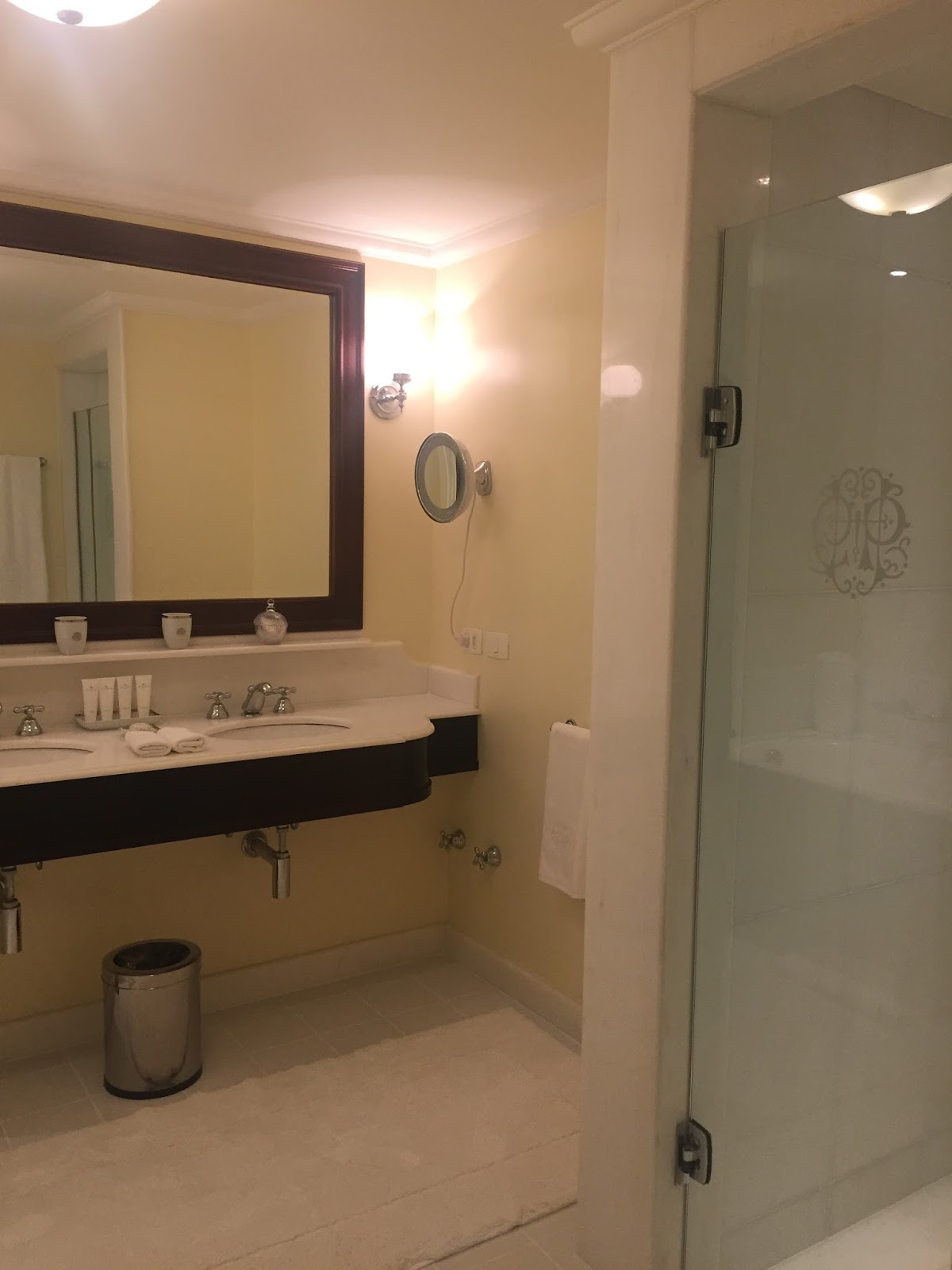
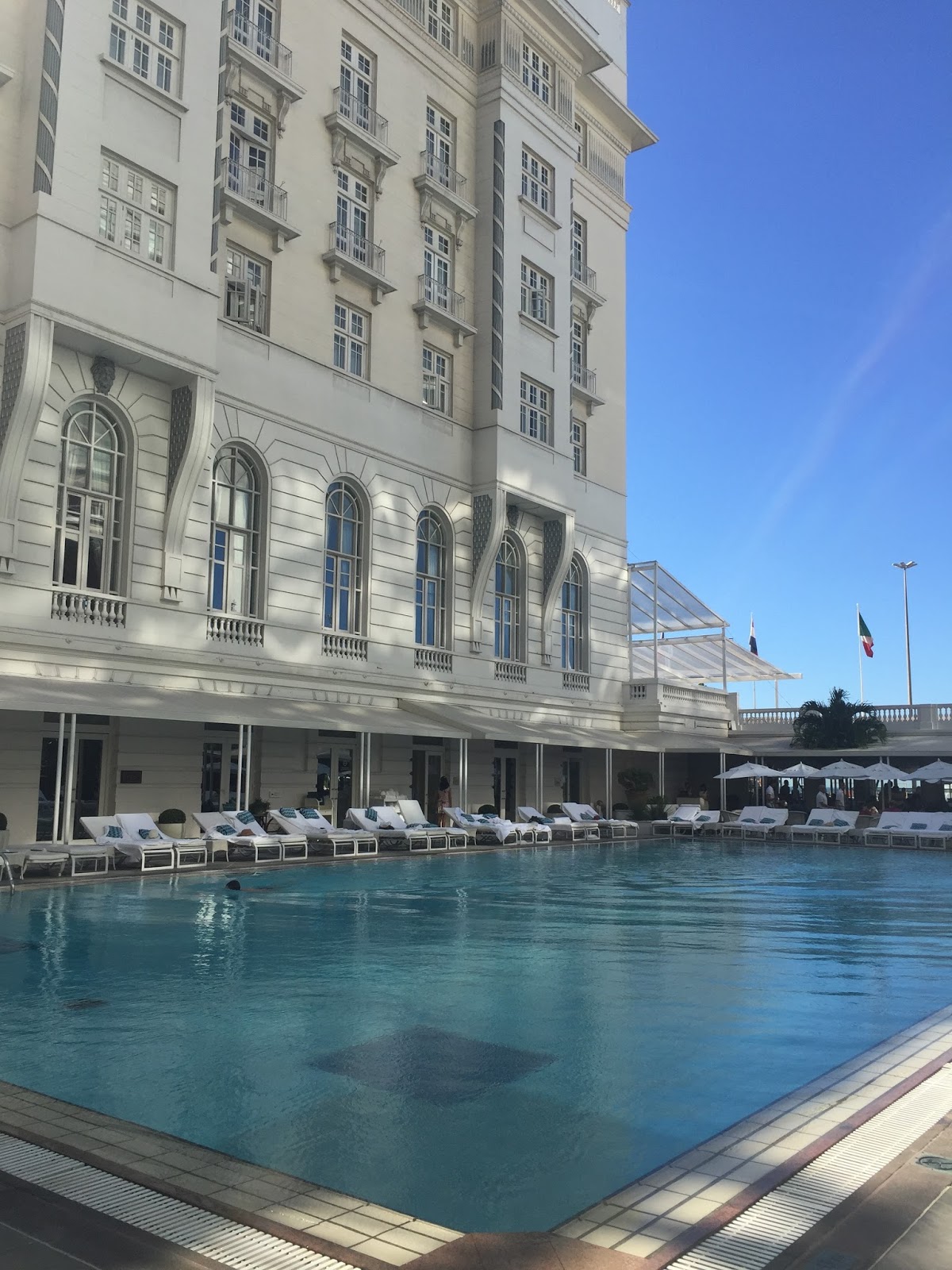
2. Stay in a hotel that has the "wow" factor. Luxurious hotels are not plenty in Rio. There are only two, according to my standards - The Fasano and Belmond Copacabana Hotel. The Fasano is located in Ipanema beach area while Belmond Copacabana Hotel is in the Copacabana beach area. The Ipanema area is more posh and more elite. But Fasano is far more expensive than the Belmond. The Belmond Copacabana starts with its superior city room at $400 a night with breakfast.
So if these pictures of the hotel didn't "wow" you enough, you should see how much let down the other hotels would be. The pool is very inviting and large at the Belmond and the food is quite good at the Pergula. Of course, you have two other restaurants which are Michelin starred, but I didn't bother to spend more money than I already spent on food.
3. Currency exchange in Brazil is a let down. I get the fact that the country is in crisis. A few years ago, the exchange used to be $1 = 2 Reals. It is now $1 = 3.55 Reals. This is how large the economy plunged. I've also said time and again that you can tell how bad the economy of the country is doing based on the quality of the denomination that is circulating. The Real is really bad. I have not seen a new currency since I was here and have changed several Reals. All the Reals are dilapidated and look like they have come from the marketplace. And the exchange is terrible. Don't change at the airport. They deduct 10% service charge and 5% in taxes from your dollars. Change in the hotel. They will take 5 Reals no matter how much you change and 5% in taxes. If you change more, you get a better rate. The current exchange rate is $1 = 3.05 Reals. Which sucks big time because you're losing 0.5 Real for every dollar you're changing. The best option is not to change a large amount of cash. Just pay with credit card and let the bank take care of the exchange rate.
(To be continued)
Sunday, January 10, 2016
Postscript of Niseko - Winter Paradise
Our annual New Year vacation was almost a year in the making.
The decision to go to someplace where the daily temperature was subfreezing and that snow would pour all day long was made after our last New Year holiday in Boracay.
MnK Niseko Resorts and Hospitality (http://mnkniseko.com) was recommended by other travelers on various websites. After a few inquiries and emails, we had finalized our reservations eight months before our travel date.
MnK Niseko has three properties - The Orchards, Chalets at Country Resort and Akazora. We picked The Orchards and was assigned to Akagashi, a three-bedroom chalet that had all the amenities of a five star residence - from the standard bathrooms, washer/dryer, living room, dining room, beautifully appointed kitchen and private Onsen Bath - the views from the upper floor to Mount Yotei or the Grand Hirafu was 360 degrees. To say that the views were spectacular from any part of the house at any time of the day, is an understatement. There are no words to describe the beauty of nature during winter and Niseko will live in our hearts and minds for a long long time.
To get to Niseko (in Hokkaido), from the Philippines, take either Cathay Pacific through Hongkong and then to the New Chitose Airport in Sapporo then a land trip from the airport to Niseko or, Philippine Airlines from Manila to Haneda then transfer to the domestic terminal in Haneda for ANA (which PAL codeshares with) for the New Chitose Airport in Sapporo.
Upon getting to Sapporo, the easiest and fastest way to get to Niseko is to drive there (right hand driving only) or Skybus private transfers (which are quite steep). The cheapest way is to take the bus which will drop you off at the Hirafu guest center in Hirafu Village. However, this has some stops and the usual 2 hour drive will take almost 3 to 3 1/2 hours depending on the weather conditions.
Arriving via Hongkong on Cathay Pacific will allow you more time to settle in as the flight arrives in the afternoon. Arriving via PAL (which is what we took) allowed us to get into Sapporo at 5:45PM, get our bags and get into the Skybus by 6:30PM and of course, get to our chalet by 8:45PM.
Tired from the almost 12 hrs trip by air and land, it was great that Clara Tan (Reservations and Guest Manager for The Orchards) did a fantastic job in patching us up with Niseko Gourmet. We had pre-ordered dinner on arrival and breakfast the following day with them and upon arrival, they had the chefs preparing dinner for us 30 mins before we got to the chalet!!! You can also pre-order some groceries (which is what we did) and had the refrigerator filled with the essentials - from eggs, bread, fruits, to butter, meat, wine and various juices, coffee, milk, yoghurt, and chocolate.
Our holiday literally began, the day we landed!
If you plan to do some shopping, you should make a few days stop in Tokyo (via Haneda) or Hongkong on your way back because Niseko is purely a winter paradise. Away from the madding crowd, it was great bonding time with the family where winter sports in all forms were available. Skiing and snowboarding lessons were available either individually or as a group. And as I would recommend for first timers, it's worth the experience.
There are tons of places to eat in Niseko, but my favorites were Villa Lupicia (that served extravagantly great international cuisine and I believe they should have a Michelin Star), and Sessa for the best shabu shabu in town. One should not miss going to Milk-Kobo in Niseko Village as it serves the best ice cream and cream puff I have ever tasted.
One of the most memorable vacations we've had and truly one where the winter weather and the picturesque view is worth a million words to describe how beautiful this paradise truly is.
I am sure we will be back...
As the saying goes, everything else, there's MasterCard. The experience and memories...priceless....
Tuesday, November 3, 2015
Never an excuse
We've always been taught that "if we have nothing better to say, to just keep quiet."
The latest spate of news on the "tanim-bala" or "laglag-bala" has placed the Philippines in the shame map once more.
First, is why would anyone even carry or attempt to carry ONE live bullet into his or her bag? And to have several consecutive occurrences of this event, is even senseless for me! The probability of consecutive "terroristic" or "criminal" activity with ONE live bullet in various individual bags is practically zero. Except of course in the Philippines.
Second, are the various media reports of this scam. Based on the first probability, this can officially be called a scam. What do OFWs, tourists, senior citizens have to gain by carrying a bullet in his/her bag?
Third, is the pronouncement of the people in government - the Aviation Security Group, MIAA Office, DOTC, and of course, Malacañan - that practically washes their hands clean of these "occasional" incidents. Someone just had to open his mouth and make the announcement that it's probably a random chance this happens. Really? Well someone should really just shut up shouldn't he?
Fourth, is the lack of sincerity at the lapses of the airport authorities over this fiasco. Apparently, all the investigations will take some time and that with the total number of people involved, there will be heads that should roll. But you can see how tough the stance of MIAA Manager Jose Angel A. Honrado is regarding the accountability of this fiasco. If this were in another country, the head would have resigned - not out of accountability per se, but out of shame. To say that our government officials in general, are thick faced (makapal ang mukha), is an understatement.
I agree that the airport officials job is to protect the safety of the riding public. After all, air transportation is an integral part of everyday travel during these times. Nevertheless, the human rights and humiliation people have to go through because of a scam, right at our very showcase window, the airport is NOT an acceptable option at any point.
It is never an excuse to protect your friends at the expense of public trust...EVER!
Sunday, July 26, 2015
Dear Ate Fely
After your column LOUD WHISPERS with the article entitled "Are resident doctors really doctors?" got published in the Mindanao Times a week or so ago, two things happened. Your column became viral on social media. And the once unknown Mindanao Times suddenly became infamous. Thanks to you.
But let me clear the clutter.
By now, you know that your column had incensed practically the whole Philippine medical and nursing profession. And you will forgive me if I say, rightfully so. I was looking for the kindest way to let you know how badly written that column was. But the Rappler had published a well written piece by a former UP-PGH graduate by the name of Dr. Adrian Rabe (http://www.rappler.com/move-ph/ispeak/100143-open-letter-resident-doctors utm_content=buffer26be9&utm_medium=social&utm_source=facebook.com&utm_campaign=buffer). He very kindly put into perspective the enlightenment that you needed on your question whether resident doctors are real doctors.
With that said, I would like to let some of my colleagues understand the field of journalism or publications. Your article is a column. As a columnist, Ms. Sicam is entitled to voice her opinion - good or bad, right or wrong - it's her opinion. That is why columns usually appear on the Op/Ed or otherwise known as the Opinion/Editorial page of the newspaper. Your being a columnist provides you with power. Used appropriately, your power of writing can change the landscape of healthcare in this country. Unfortunately, like many other two-bit columnists in this country, you managed to utilize that power to the disadvantage of the people. It was, self-serving.
That, my dear Ate Fely, was why the response to your column was a violent one.
As a former Varsitarian (Official Student Publication of the University of Santo Tomas) staffer, I learned that accountability, responsibility and integrity are the hallmarks of a true journalist. Someone who would check facts first, balance his/her opinion, and ultimately be accountable for what one writes.
I do not hold you solely accountable for the mess that you're currently in. The editor-in-chief and publisher of the Mindanao Times are equally culpable for the backlash that you're receiving. After all, your boss has the right to publish your article or not. He could have called your attention and discussed with you the merits of publishing the badly written and poorly edited column you wrote. The mere fact that he/she decided to publish your column and do a Pontius Pilate later on is proof that he didn't have enough spine to back you up when the going got rough. In short, he decided to crucify you. That to me tells me what kind of a douchebag your editor is.
In all honesty, he was equally as culpable as you. In the publications world, it takes two to tango. The writer and the publisher (unless you are both).
I recently found out that you had written to your Acting Editor regarding the atrocious comments you've been receiving on social media (Facebook most especially) and the letters to the editor of the Mindanao Times.
Do I commiserate with you? Sadly, no. While I am trying to understand that what you did for your friend was through the goodness of your heart, you did not dig deep into that very heart to understand the travails of healthcare in the Philippines. There was no injustice done by the resident or the nurse on duty that fateful day you brought your friend to the ER of PGH. That is the way the public health system is in the Philippines. If it will make you feel better, I have a colleague who went to the extent of suggesting that there should be a law that requires ALL GOVERNMENT EMPLOYEES AND OFFICIALS UP TO THE PRESIDENT OF THE REPUBLIC OF THE PHILIPPINES to be seen and confined ONLY at government hospitals so that they have a reality check every now and then, and that the public healthcare system be upgraded for the majority of its citizens. And I totally agree!!! As to how many government officials actually have the balls to make this into a law, this has to be an acid test for the government.
After reading your letter, I can only say that you are not a writer. Not a journalist. And never will be at your age. I will offer you one advice - retire. It's not your cup of tea.
Thursday, July 9, 2015
Fucked up!
This will be one of my shortest blogs.
Over the last weeks, there have been very annoying posts and shared posts of the most unshareable material on the internet.
It ranged from Kris Aquino's dissing of Maria Ozawa, to the teenage Pabebe girls who were ranting like bitches with their annoying video, to the possè Atenean doctor who bragged about mulcting a delivery boy over P200 of greasy fast food, to the bromance and defense of the Pinoy Big Brothers involving a minor and an adult.
Are these even worth the news or a minute of people's time? If you think that following these posts and dedicating time to these are worth the while, think again. You just wasted precious minutes in your life doing something more worth the while, than following people with fucked up lives!
Yes. These are people with fucked up lives. They are scums of the earth. They are meaningless. They have nothing worthwhile to share. That's why while I blog about the events, they should be remembered as useless people whom media and the internet has provided a two minutes spot at fame and infamy.
Next time you post or share, don't bother with the fucked up lives.
Sunday, May 24, 2015
Pandora's Iceberg
It was disturbing to read on the news the suspicious P2 Billion claim filed by Philhealth affiliated hospitals and clinics for fraud.
http://www.pressdisplay.com/pressdisplay/iphone/homepage.aspx#_article947412871
It drew another blow to the medical health profession that was reeling from allegations of tax evasion by the Bureau of Internal Revenue, bidding and research irregularities in the public health service, and unethical relationships with the pharmaceutical industry. It saw health care receiving the brunt of criticism from a public that was dissatisfied with the care that we, as physicians swore to uphold with the highest ethical standards.
There is a clamor to restore the image of the physician to align with more appropriate ethical practice. The question is, why has this happened?
Greek mythology has it that Pandora, the first woman on Earth, was endowed by the gods with several attributes of goddess qualities. Pandora was gifted a box full of evil by Zeus. As the story would have it, Pandora's curiosity (much like Eve's curiosity of the apple tempted by the serpent in the Garden of Eden), would release all the evil (including death) in this world. By the time Pandora realized what she had done, she had released all the contents except for one thing that laid in the bottom.
To open Pandora's box figuratively emanates from that story. A small act or seemingly innocent one at first can have a domino effect and result in far-reaching consequences by the time we become aware.
Undoubtedly, the root cause of all the inappropriate behavior of the physician is financial remuneration. Not that financial remuneration is bad. It's how we earn our keep that matters.
To understand why this happens is not within the realm of this blog. There is no excuse for such behavior in any profession. Why the medical profession is highlighted is a different story altogether. I guess it's because people consider the health profession a noble one. What once was a simple doctor-patient relationship became complicated with third party business providers and as the future evolved, so did health care. The HMOs were the business boomers. They turned health care into a business far beyond what the naked eye could see. The HMOs took advantage of both the doctors and the patients. It's rubbish for any one to claim that their HMO business is to benefit the patient, and make it worthwhile or profitable for doctors to get reimbursed. For god's sake, an HMO is an insurance company. Why do you think they even came up with business models like these if it's not profit oriented?
HMOs sell health insurances to companies in guise of a "perk" being provided to employees. Employees believe that this perk is a right to badger the hospitals or doctors whenever they feel there is a need to utilize their insurance. You see patients in the emergency rooms with health cards demanding to get seen for a health problem that should have been seen on an out-patient clinic. But since they're too lazy to go and make an appointment with their doctor, they will use limited resources from their health card since to them, the ER visit is "free" anyway. They're also the same ones that abuse the hospitalization privileges. Even mild viral infections are admissible cases to them. They will DEMAND that they or their children get confined and worked-up, simply because they can claim leaves of absence from work or won't have to pay for medicines, or simply take advantage of the whole insurance health care system scheme. They will connive and coerce doctors to utilize their health cards even if the first admission was not admissible and the next admission is a true emergency but is the same illness as the first. Their reason - it's paid for anyway! And when their credit limits are breached during the hospital stay, they're also the same people that will DEMAND that they get discharged at once because they're not willing to dish out additional expenses for patient care. Those belonging to the lower rung of the totem pole in the corporate ladder has the highest utilization for HMO privileges.
Patient care.
Where does the physician fit in this complicated business maze?
The HMO-affiliated doctor simply gets a drop in the bucket. The biggest share goes to the hospital or clinic and the HMO. That's the reason why some HMOs do not like hospitals that are too expensive because their bottom line costs will bloat and patients will not benefit from exuberant costs in hospitals. Which goes to the point of having to "standardize" the hospital payment cost of every HMO to any and all hospitals that want HMO affiliation so that patients will benefit from the insurance cost. Regardless of whether the patient would want to get admitted to Hospital A in Pasig or Hospital B in Taguig, the HMO pays the standard cost to the hospital for the procedure, hospital stay, professional fee and medicines in the hospital. At the current scenario, only the professional fee to the poor doctor is standardized. If the professional fees can be standardized, why not the other costs of board and lodging and procedures in the hospital? They are, after all, more static and negotiable by hospital administrators with their suppliers. As a matter of fact, it is obscene that the physician does not enjoy the same perks and benefits as the nurse or the occupational therapist or the pharmacist or the CEO of the hospital because the doctor is NOT an employee and has no privileges at all. When doctors get sick, sadly the hospitals they work for don't and won't take care of their medical expenses. There are very minimal, if any, medical privileges provided by hospitals to their doctors. The rationale of hospital administrators is that while doctors bring him patients to the hospitals (and are therefore its major source of income), the doctors also financially benefit from hospital admissions for patient care. A seriously absurd corporate mentality!
Which leaves us with the question - do these aforementioned scenarios justify the unethical practices of physicians in the profession? The answer is NO. But the last two decades has seen the boom of the HMO - as a business. It has transformed the paradigm of health care from one of personalized care, to one of big commerce. I am not saying that a HMO is totally bad. It just needs to be totally redefined to both educate the beneficiaries as well as appropriate the scarce resources to more admissible medical conditions and just compensation for services rendered. It should design packages that absorb costs of preventive health care such as immunization in children and not for adult health lifestyle check ups alone.
This applies also to Philhealth. There's so much money in reimbursement to physicians involved when it came to cataract surgery (which according to the ophthalmologist of my mother, is a relatively quick procedure like pulling out a tooth) compared to how much we are reimbursed for moderate to severe pneumonia, which is life-threatening and has higher mortality than cataract surgery. I recall my mom's cataract surgery went for one hour and the doctor had gotten P16,000 from Philhealth. I had a patient who had very severe pneumonia (TB Pneumonia) and got P3,600.00 from Philhealth for a 16 days hospital confinement which included a closed thoracostomy tube insertion! As to what the basis for the professional reimbursement costs for various medical cases by Philhealth were - your guess is as good as mine.
The paradigm shift in the practice of medicine has gone from healthcare practice to healthcare business.
Because we don't have a lot of benefits unlike full time employed workers, some often ask the question "what's in it for me"?
The answer - none. And there should be no expectations set to to our younger colleagues.
You see, I never wanted to be a doctor. So I guess that's why my outlook is quite different. I eventually found out after graduation and my years of practice, that one cannot expect to get paid for everything one does in the profession. That the anatomy of disappointment are expectations. And that I learned to love what I do and I have passed up many opportunities that came my way for better and more stable pay in place of my private practice. At the end of the day, it's liking and loving what you do - not for the hefty cash you bring home (which is the icing on the cake) - because you know you're really good at it! Making kids better, making your profession more meaningful, adding extra years to lives that would have been zapped up had you not cared for them.
Medical practice is an art. It's not a business. Some big business changed the way health care has evolved. I guess all the commercialism and hullabaloo of who makes more and what car he or she drives or how many foreign travels one has in a year is the mark of success for some of us in the medical profession. If these are the drivers and parameters of one's success in our profession, I don't think we will be happy in what we do. There is nothing wrong with earning. But we cannot build a reputation where business speaks louder than the care we provide to patients. We need to shift the tides back to the question - why did we become doctors in the first place?
As many of these challenges collide with one another, like an iceberg waiting for a major disaster to occur, I hope that many of our leaders in the health community see the situation as an opportunity to change the tide.
Everything came out of Pandora's Box that day. From greed to envy. From despair to loathe. She allowed all the contents of the box out.
All except HOPE.
Subscribe to:
Posts (Atom)